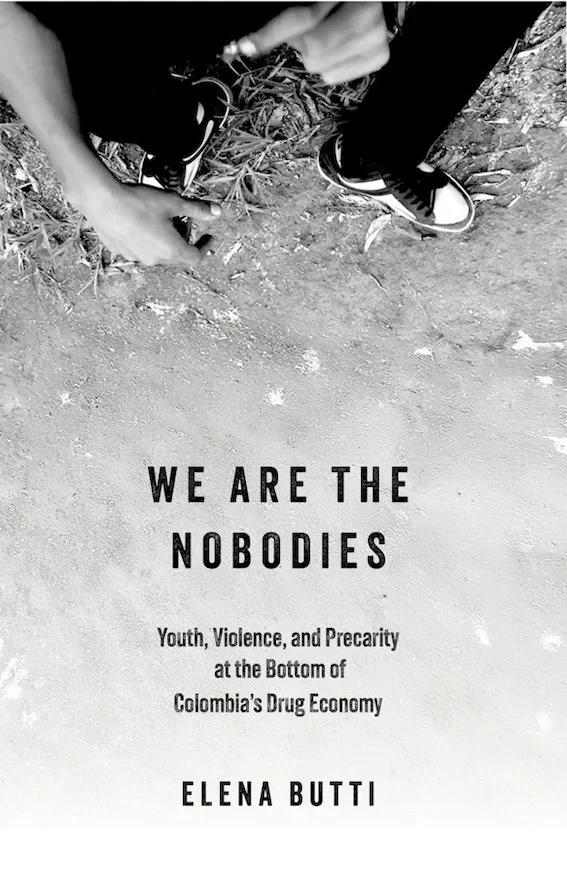
We Are the Nobodies
Youth, Violence and Precarity at the Bottom of Colombia’s Drug Economy | NYU Press, 2027
In the 1990s, Medellín, Colombia, sadly rose to fame as the “most violent city in the world.” Following a stark homicide drop globally known as the “Medellín Miracle,” it is today recognized as a model of urban resilience and innovation. Yet behind this linear account of transformation lies a more complex reality of persisting violence affecting the city’s most precarized youth.
We Are the Nobodies offers an immersive ethnographic look into the world of adolescents working at the bottom of the contemporary drug economy in Medellín and its surrounding region: the small-scale dealers, the drug carriers, the barrio watchdogs, the gangster wannabes.
The book links their experiences to changes in transnational drug markets, notably the economic crisis Colombian criminal organizations suffered when Mexican cartels took over their direct export link to the U.S. Now earning half what they used to, Colombian organizations have refocused on the domestic market, expanding their exploitation of their bottom-level adolescent workforce.
Unlike classic U.S. ethnographies focused on gang leaders or older drug dealers, this book shifts attention to the expendable young lives that sustain this transnational drug economy. Individually, these lives do not matter much. Collectively, however, they constitute the fuel that keeps this global criminal enterprise running.
Drawing on a decade of ethnographic research, Elena Butti reveals how these adolescents are recruited with promises of respect, economic returns, and upward mobility—yet end up caught in an exploitative criminal machine that deprives them of all rights, even the right to live. Often portrayed as a threat to be contained, they are in fact trapped in a vicious cycle of heightened vulnerability that becomes ever harder to escape.
The book argues that low-level work in the drug economy is thus not an emancipatory experience but a vehicle of neoliberal exploitation. It illustrates this through a parallel with gig economy business models. Starting as young as eleven or twelve, the youth in this book perform petty tasks, get paid in drugs, and become addicted to the very drugs they sell. Like gig workers, they lack any sense of belonging to the organization and can be dismissed, replaced, or killed the moment they become inconvenient. Earlier notions of strong membership—“my gang is my family”—have eroded in favor of looser, exploitative types of affiliation. While many aspire to build a career within the criminal world, most remain stuck at the bottom due to a rigid corporatist logic that allows little upward mobility. In the context of global discussions about the neoliberal precarization of work, the experiences of these youth illuminate what precarity means for those at the bottom of illegal economies, where insecurity is not only material but ontological, and where death is simply part of the job offer.
Engaging, accessible, and written from the rare perspective of a woman ethnographer, We Are the Nobodies speaks to audiences concerned with drug policy, organized crime, Latin America, and the future of work, revealing what it means to live—and die—at the bottom of a precarized global illegal market.